AI versus Marshy 75 - Reconciliation
AI versus Marshy 75 - Reconciliation
the best thing I can do is act in a way that makes things happen instead of reacting to a world that doesn’t know what’s happening…
I went to a Roman Catholic school and learned a sacrament called ‘reconciliation’.
It was also called penance - and what you did at some intermittent amount of time - would be to visit a box and reveal to the priest who’s sitting behind the curtain your sins, and be awarded some prayers to say that would reconcile the bad things I’ve done.
That’s how I feel right now.
I started AI versus Marshy with some explicit self-goals because I could see what was coming.
AI was going to be bigger than anything the planet’s ever seen in terms of technology.
And my experience with technology had been rewarding.
I got in on digital marketing early and saw my career prosper.
Working with global clients, at two of the world’s biggest tech companies, and enjoying an abundance of opportunity.
So seeing AI as a similar pattern unfolding, but at a much, much larger scale meant I needed to get my head around it fast.
Now I’m naturally a fast learner anyway, but I knew that if I forced myself to write about it, it would accelerate my learning curve.
This would be advantageous because I’m already a fast learner, and then learning rapidly about one of the world’s fastest-growing technologies in terms of capability was going to give me more advantage in life.
That intention has largely become true.
I am not a developer. I’ve been siphoning this stuff up first with bemusement and speculation.
Then morbid disbelief.
Now - I feel like I’m at a juncture where I’ve got my head around it.
I know more than most - it’s bewildering to me that I could see what’s happening a good two and a half years ago.
And if anything, collective awareness of what’s unfolding is almost lower than what it was with those initial hype bubbles around ChatGPT or GPT 3.5.
I don’t necessarily blame people for this.
This is an ugly, juvenile speedrun towards some sort of black swan event.
We can’t guarantee is great for the world, and we sure as hell can’t guarantee that there’s zero chance of some form of existential risk.
Rereading the above sentence sounds ridiculous.
When I started writing this stuff, I was like, okay, this is going to help me make sense of things. Let’s share things with a small audience and learn together along the way.
But I can’t write that way anymore.
Not because I it doesn’t have merit. I know a number of kind people that are really good at meeting people where they’re at, being patient, and sharing how they learn.
But because I’m actually trying to solve bigger problems for myself now due to this accelerated learning curve.
For the first time in my career, the problems I’m solving for are not resource-constrained or technologically restricted.
Meaning: I have enough access to tokens and tools and knowledge that right now, today, I can build whatever the hell I want on the web and in applications, and it will do a good enough job based on what my intention is.
Over the last 6 months, I have built things like:
-
A multi-calendar widget for tracking when certain appointments can be booked in what calendar across four different email accounts. Now that sounds easy.
It’s surprisingly hard when you add different appointment booking software and different Google suites.
Earlier this year, I was at the point where I thought I better just buy a third party piece of software that solves this.
Then I had the bright idea of asking Claude Code, and bang, it was able to turn around a solution that I’m still using six months later in about twenty minutes. -
I’m working for a company that has been using Webflow for a number of years. It had a website, my business partner was very frustrated by it. \
So we did a competitive analysis, looked at the existing branding, what our unique positioning was relative to the market, what our products and offers were, what sort of tone of voice we’d like to take, and what visuals and brand assets we already had that could be adapted for a new website.
Then just shipped it and replaced the $79 per month Webflow subscription in the space of a couple of weeks. -
A segment of this audience might remember my writing about ADHD and keeping an eye on AI tools that could help in this space.
I am sick of being distracted by Slack, pop-ups, different websites, different feeds, different chat interfaces, different emails.All of these portals towards distraction are necessary evils within the work I do. Yet I knew for my attention span I was getting slaughtered and it was death by a thousand cuts. \
So over a weekend I simply built something called Focus Tunnel that blocks everything in quite a nuclear way, using an app I already had called Cold Turkey and another interface called Hammerspoon.
When I have the discipline to turn it on, it tracks when I’m drifting away, keeps me locked into the tools I have committed to using, has an overlay on the screen that says the task I’m doing and gives me options for breaks.
This was something that I wanted to build in founder mode a couple of years ago, and I was able to spin it up quickly and build it fit for purpose with what was in my head.
I share this not to brag, because things like this aren’t impressive to me anymore.
In the speaking I’ve done on this topic, I talk about the Uber effect.
The first time we order a vehicle via a maps interface and it shows up at our doorstep seven minutes later is an awe-inspiring moment.
Yet once I became acclimatised to this kind of service, I remember also being frustrated by seeing an Uber that was three minutes away, it failing to come and being 10 minutes late, and me being absolutely furious.
We’re living in a time line where the Uber effect is going to be compounded and increased by multiple orders of magnitude.
And I’m standing here scratching my head, asking the world if they know what’s coming?
So that’s why I’m returning to my writing, wringing a rag between my hands.
I have bigger problems to solve for, and they’re not resource-restricted or technology-restricted.
Ironically, the problems I’m solving for now are much more human.
I’m a knowledge worker. I see a not too far away time horizon where what I do and what I can do is largely “solved”.
So what does that mean for me as a human being?
Where can I add value?
Is anyone else thinking about this?
How can I ensure that the relationships I cultivate are real and help the people around me?
How do I ensure that where I’m spending my energy is time well spent?
…and perhaps most importantly, and why I’m writing this today:
How do I disaggregate the slop and clutter that’s coming my way at a million miles an hour in order to think more clearly, share more openly, and simply do things for their own reward?
I don’t have the answers to these things, and know they’re incredibly important.
So I’m putting this out there, and will agitate on it, and see what happens.
Because I believe the best thing I can do is act in a way that makes things happen instead of reacting to a world that doesn’t know what’s happening…
-Marshy
p.s. Oof. That felt therapeutic
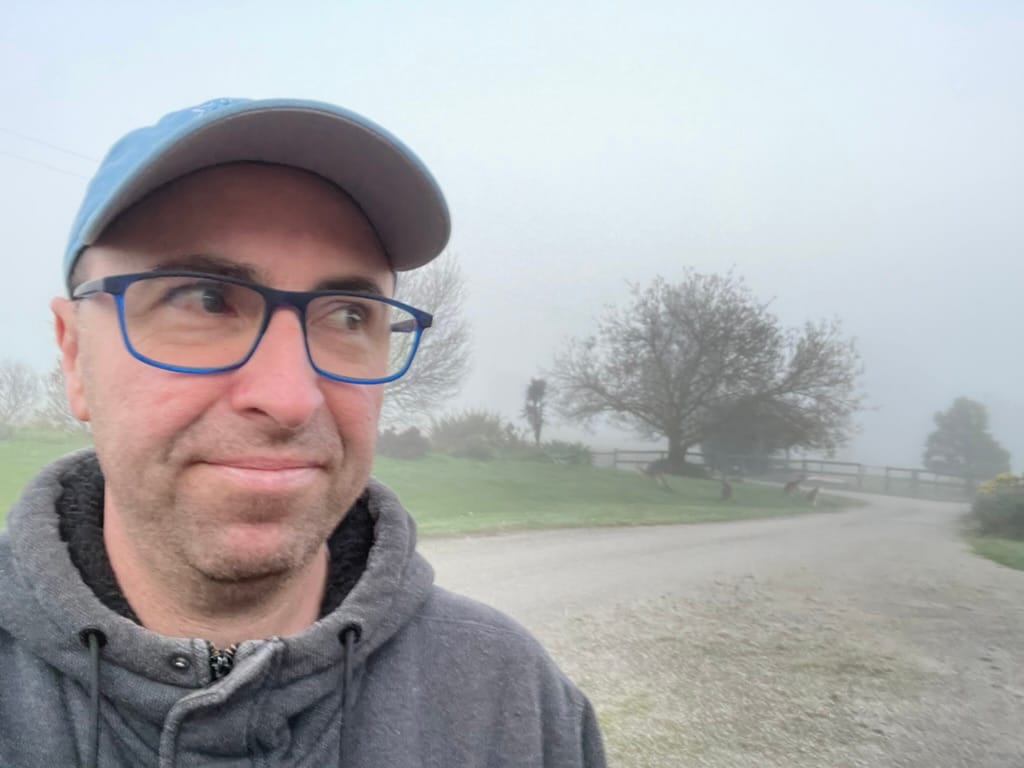 Ever felt surrounded by fog?
Want more of this?
Weekly-ish thoughts on AI, growth, and being human in tech. Sometimes useful, sometimes not.