Notice · Chapter 75 · 2 min read
Track what you do
It was only a matter of time before someone smart came along and said, “It doesn’t have to be this way. The tools of the Internet and social media have made it possible to track, test, iterate, and improve marketing to the point where these enormous gambles are not only unnecessary, but insanely counterproductive.”
- Ryan Holiday, Growth Hacker Marketing: A Primer on the Future of PR, Marketing and Advertising
Most what I do today is strategy.
So it might be surprising to hear me say I’m not a fan of strategy when you’re starting.
It’s much better if you simply try a lot of low-risk things, identify what works for you and your business, and then start planning further ahead.
The only caveat I’ll add here - is that you need to track what you’re doing. Tracking what you do creates markers over time, that you can look back on, to start creating a roadmap for how to do it again.
Without tracking, you’re simply spraying energy in all sorts of directions without knowing what is working.
You got a taste of what tracking looks like way back in A crash-course on desktop research.
To start, I suggest you track things in terms of weekly campaigns.
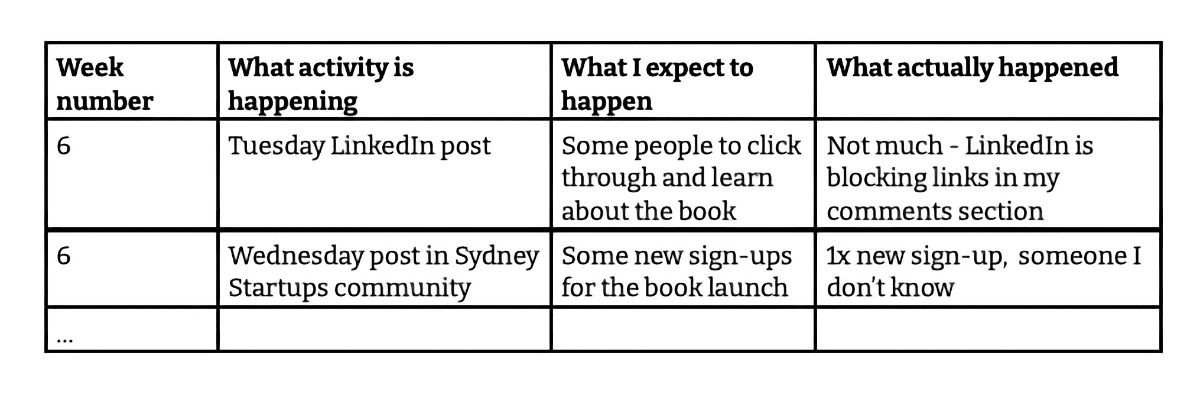
Create some columns with the week number, what activity is happening, what I expect to happen, and what actually happened.
Each row will look something like this:
What you’re doing is building your noticing muscle.
What you’re looking for is some accurate predictions. They’ll be fairly modest to begin with, yet over time you’re building a knowledge library of what works and what doesn’t. This knowledge is incredibly valuable, and allows you to benchmark your own marketing performance.
You might find that every time you collaborate with someone on social media who has a bigger audience than you - you gain 5-10 new followers.
You might find that every time you email 100 people on your list, you get 10 or so that will click the link.
These are small wins that become big wins.
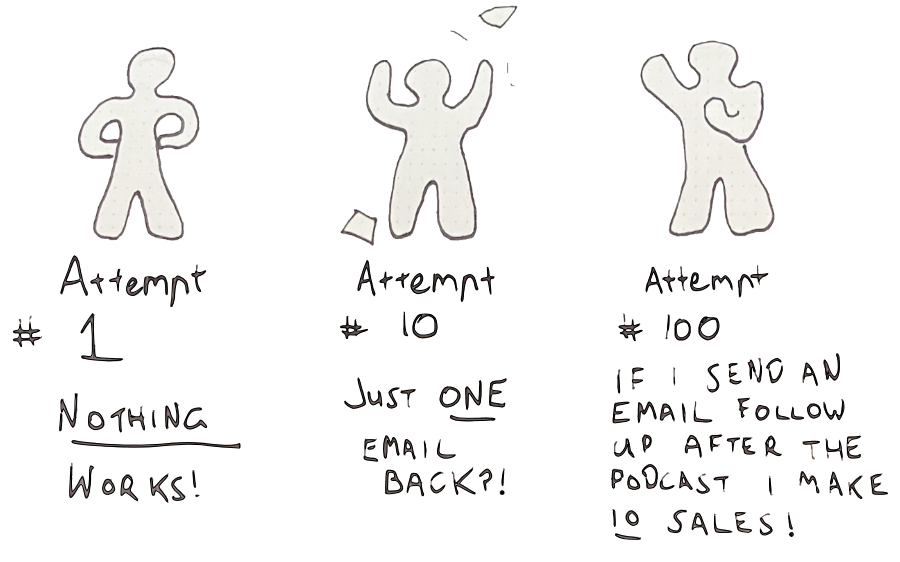
Remember our friend the 1-10-100 rule?
Your knowledge map might look like this:
An ever-growing playbook.
Once you learn how to get results out of one channel, you become quicker at identifying what works in another, then you notice it’s repeatable in another, and over time it becomes satisfying being able to anticipate and plan for desired results with less wasted effort.
Related chapters
What did you think?
Tell me what landed, what didn't, or what's missing.
Give feedback on LinkedIn →